
When you add a temporary space for your business, one of the earliest questions to answer is about temperature. Depending on what is going into the space, the temperature requirements can vary considerably, and this is where insulation comes in.
Differing needs
At the top of the temperature gauge will be people. Depending on the work, temperatures should be between 13 degrees Celsius (for strenuous work) and 27 degrees.
If the space is a warehouse, storing stock with people popping in and out, temperature tolerances can be a little different, but you still need to be careful. Ambient foodstuffs shouldn’t be chilled and definitely not frozen. Chemical storage will require strictly controlled temperatures etc.
Too warm is just as much as factor as too cold.
Here’s what needs to be considered and how we help you control temperature in temporary spaces…
The Walls
Our temporary spaces are created by erecting a steel frame to the size you need it. We have a number of standard span widths (starting at 7 metres), a range of eaves heights (from 3.3m to 6.2m) and the length can be any number of 5m increments (see our full range here).
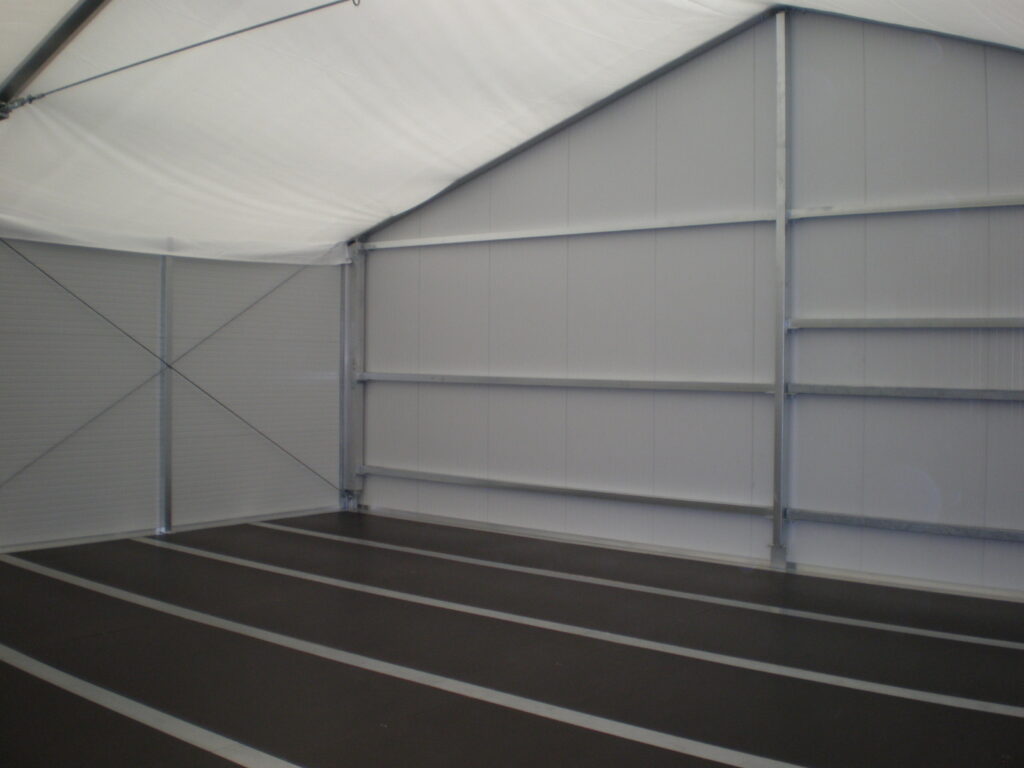
Insulated Sandwich Panels
For longer-term temporary facilities, insulated composite panels provide high thermal performance and improved acoustic control — an additional benefit in busy environments with forklift traffic and machinery.
Installing a suspended thermal liner beneath the roof creates a cavity that reduces heat loss and condensation.
They are fast to install and particularly suitable where staff are present daily, as they significantly reduce radiant heat loss and internal temperature swings.
Rigid Insulation Boards
For metal-clad temporary buildings, rigid insulation boards such as PIR or mineral wool can be installed between structural members. Boards must be tightly fitted to eliminate thermal bridging.
This solution is appropriate where consistent temperatures are required for both stored goods and personnel comfort, particularly in operations involving manual handling or detailed picking tasks.
Prioritise the Roof
Heat rises, and the roof is often the primary source of heat loss in winter. In the summer a PVC roof can quickly heat up the space too.
In warehouses where people are working at ground level, poor roof insulation creates uncomfortable vertical temperature gradients — cold air at floor level in winter, excessive heat build-up in summer. Improving roof insulation helps stabilise the working environment and reduces reliance on heating systems.
At Quick Space we use a suspended liner to create a cavity that can reduce heat loss and reduce condensation too.
Control Condensation and Air Quality
Warehouses with active staff movement generate internal humidity through respiration, vehicle movement, and operational processes. Without adequate vapour control, condensation can form on structural elements and drip onto stock or workstations. Air hits surfaces that are colder than the air and condenses into water droplets. Gravity takes that water downward, causing potential slipping issues too.
In spaces with regular personnel activity, balanced airflow improves both air quality and temperature stability. Installation of de-humidifiers can help make the difference.
Consider the Floor

Concrete floors absorb cold and radiate it back into the space. For staff working long shifts, particularly in picking or packing zones, cold floors increase discomfort and can contribute to fatigue.
In most situations where the floor needs insulating, we install a suspended wooden floor. The air gap reduces thermal radiation, keeping the air and your people a little warmer.
Manage Doors and Access Points
Frequent opening of large roller doors disrupts internal temperature control. In facilities with active loading operations or high staff movement, heat loss can be significant.
Options include:
- Insulated roller shutter doors
- High-speed rapid-rise doors
- Dock shelters
- PVC strip curtains for zoned working areas
Reducing heat escape protects both stock and working conditions.
Efficient Heating
Insulation reduces heat demand but does not eliminate the need for climate control. Hot air blowers with boilers set up safely outside the structure are also effective for large areas, circulating the warm air within and expelling the cooler air back out. They have the added advantage of being able to circulate cool air in the summer months.
When specified correctly, insulation transforms a temporary warehouse from a basic storage shell into a stable, productive environment that supports both inventory protection and the people who keep operations moving.