
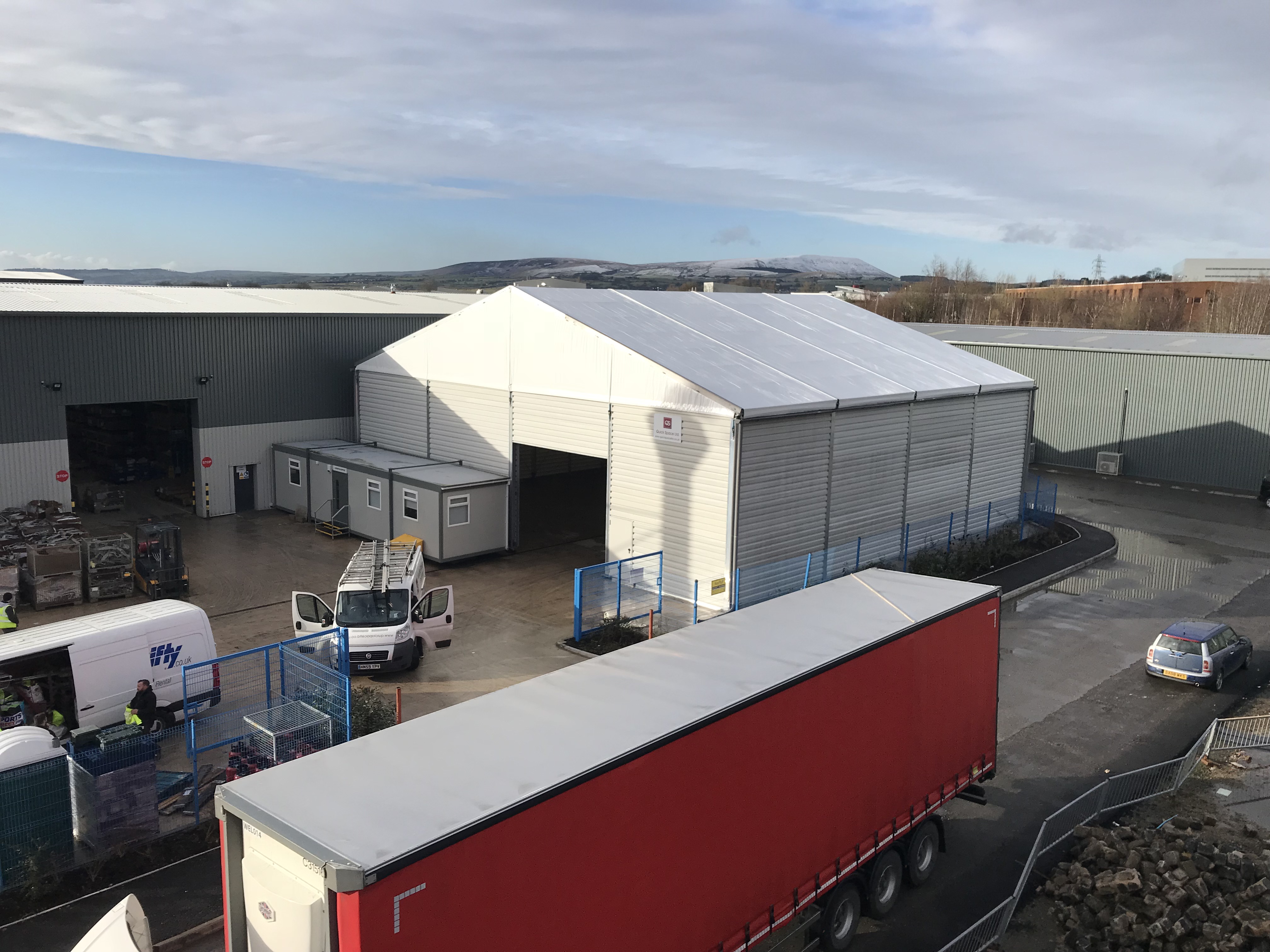
When a growing business begins feeling the squeeze on space, warehousing becomes a strategic decision, not just a storage problem. Whether you manufacture, assemble, or distribute, the way you expand capacity affects cash flow, efficiency, and long-term flexibility.
There are three common options (click on the one you want to read about first):
- Temporary warehouses on your site
- Permanent warehouse on your site
- Leasing warehouse space somewhere else
Here is a clear look at the advantages and drawbacks of three common options.
Building a New Permanent Warehouse on Site
This is the traditional expansion route and often seen as a long-term investment in the business.
Pros
Full control and custom design
Designing a purpose-built warehouse around your exact workflow, racking systems, production flow, and future automation makes real sense. Once the site is open, efficiency improves from day one, supporting advanced systems such as robotics or high-density storage later on.
Operational integration
Being on the same site as your existing operations reduces internal transport, double handling, and communication gaps between production, warehousing, and dispatch. That typically leads to lower labour costs and faster order fulfilment.
Long term asset value
You are investing in property rather than paying rent. Over time, this can strengthen your balance sheet and give you a tangible asset that may appreciate.
Brand and customer perception
A modern, permanent facility can reinforce the image of a stable, growing, well established business, which can matter to major customers and investors.
Cons
High upfront capital cost
Land preparation, construction, professional fees, and fit out require significant capital. You’re tying money up in bricks and mortar rather than product development, technology, or market growth. Take a look at our analysis of what a small warehouse costs to build here.
Long lead times
Planning permission, design, and construction can take many months, sometimes years. If space pressure is urgent, this may not solve the immediate problem.
Reduced flexibility
If your storage needs drop due to market changes, new supply chain models, or shifts in product mix, you are left with a fixed asset that may be underused.
Site constraints
Your current site may have limited room for expansion, access issues for larger vehicles, or planning restrictions that make building difficult or expensive.
Leasing a Warehouse at a Separate Location
Leasing external space is often seen as a faster and more flexible route to increasing capacity.
Pros
Lower upfront cost
Leasing avoids the major capital expenditure of construction. Spreading costs over time as operating expenses can be easier to manage from a cash flow perspective.
Speed of implementation
An existing warehouse can be occupied and operational relatively quickly compared to building new premises.
Scalability
Lease terms can sometimes be structured to allow you to expand, downsize, or relocate as your needs change. This suits businesses in fast changing markets. On the other hand, leases may come with infrequent break opportunities and long notice periods, so be careful!
Location optimisation
You may choose a site closer to key customers, ports, or transport hubs, improving distribution efficiency and reducing delivery times.
Cons
Ongoing rental liability
Rent, service charges, and business rates are continuous costs. Over the long term, this can exceed the cost of owning your own building.
Split operations
Running multiple sites adds complexity. You may need extra management oversight, duplicated equipment, and additional transport between locations, increasing costs and the risk of errors.
Less control over the building
You are limited in how much you can modify the facility. Structural changes, mezzanines, or major automation installations may be restricted or require landlord approval.
Lease risk
At the end of the lease, you may face rent increases, relocation pressure, or loss of a strategically useful site.
Adding a Temporary Warehouse on Your Site
Temporary structures have become a popular middle ground.
Pros
Fast installation
Installing temporary warehouses takes just days or weeks rather than months. This makes them ideal for rapid growth, seasonal peaks, or short-term contracts.
Lower capital outlay
Costs are typically much lower than permanent construction, especially if the structure is leased. This protects cash flow while still increasing capacity.
On site integration
Like a permanent on-site build, a temporary warehouse keeps storage close to production and dispatch, reducing handling time and internal transport costs.
Flexibility
Extending, reconfiguring, relocating, or removing these structures can often be easily done as your needs change. This supports a more agile, future focused property strategy. Take a look at some of the projects we have done.
Planning advantages
In some cases, temporary buildings face simpler or faster planning processes, though this varies by location.
Cons
Perception and longevity
Some temporary solutions, such as marquee-style solutions, may be viewed by some customers or stakeholders as less robust or less professional. Other solutions, particularly those constructed in metal, are likely to have minimal negative impact.
Thermal performance and environment
While insulation options exist and can be effective for temperature and humidity control, temporary buildings may not match the environmental control of a fully insulated permanent warehouse without additional investment.
Finite lifespan
Whilst they are not usually intended as multi-decade solutions; they are rated as semi-permanent. Over a very long period, cladding replacement or upgrading may be needed. However, some of our temporary warehouses have been on-site for 10+ years with every little maintenance required.
Site space still required
You still need available yard or land area on your existing site, along with suitable ground conditions and access.
Taking a Forward-Looking View
The right choice depends less on today’s space shortage and more on where the business is heading.
- If your volumes are steadily rising and your product range and processes are stable, a permanent on-site warehouse can be a strong long-term investment.
- If demand is uncertain, markets are shifting, or you are testing new regions, leasing offers some flexibility with lower upfront financial commitment.
- If you need space quickly, want to protect capital, and value the ability to adapt as your operation evolves, using a temporary on-site warehouse can be a highly strategic stepping stone rather than just a stopgap.
Many growth focused businesses now treat warehousing as a phased strategy. Temporary or leased space is used to respond to immediate demand while planning permanent facilities only when long term requirements are clear. That approach protects cash, reduces risk, and keeps your operation agile in a changing market.